Fall Digest: MozFest, Clampdown Against Turkish LGBTQ, Brazil, and Other Global Tech in the News
We’ll be at MozFest soon, talking about precision-washing and convening. Plus, global shifts, news that we are monitoring, and updates on what our community is up to.

We are excited to convene at the Mozilla Festival from October 28-30 in Barcelona, Spain this year, where we will join our community in exploring the theme of Wilding. This idea that our digital world can be re-imagined and tended to, much like our natural world, comes right on time. The festival’s director, Zeina Abi Assy, describes this notion in her first-person essay about growing up in Lebanon among two lineages: journalism and farming.
It seems that for many of us, the personal continues to become increasingly political as we watch the themes of our own work directly collide with the lives of our loved ones. This year, the De|Center’s Afsaneh Rigot will speak on the first day of the festival about the precision-washing of AI weapons, including a more familial lens. Across Palestine, Lebanon, Iran, Yemen and beyond, people are being told that AI facilitated technology is making war more "surgical" or “precise,” even as they watch homes, schools, hospitals, roads and entire communities destroyed. We look at this propaganda and marketing language for weapons to understand the intentions of these tactics, how it is obfuscating war crimes, and perpetuating and scaling atrocities.
Our second panel will address the importance of convening, after we had to abruptly change course when RightsCon was cancelled in Lusaka earlier this year. More recently, we saw US pressure on the European disinformation conference, which led sponsors to withdraw. What does this mean for civic space and community organizing? Afsaneh will join Nikki Gladstone, Rachael Kay, and Zaina Abi Assy, the directors of AccessNow, IFEX, and Mozfest, respectively, in what promises to be a valuable discussion.
Panel Details: See You There?!
‘They Calculate Our Lives With Machines’: The Precision-Washing of AI Weapons, Wednesday, October 28, 12:30 PM - 1:30 PM (CET), E1 Stage
Convening Under Pressure: Rethinking How We Bring Communities Together Thursday, October 29, 4:45 PM - 5:45 PM (CET), E1 Stage
We are always working, always monitoring. Here are some of the shifts in global tech news that we have been watching closely.
Queer Repression in Turkey and Senegal
In Türkiye, the De|Center joined over 450 organizations condemning the crackdown on LGBTQI+ communities. We are extremely concerned that in the last few days, following widespread raids, device seizures, and mass detentions (including 116 reported in September), a new operation on Friday night saw 45 people, most of them trans women, taken into police custody across seven cities: Ankara, Diyarbakır, Mardin, Çankırı, İstanbul, Bolu, and Antalya.
The investigation reportedly centers on social media posts that the Ankara Chief Public Prosecutor’s Office alleged were “against public morality,” targeted families and children, “encouraged genderlessness,” and disrupted public order. An “obscenity” charge was also cited. At the time of reporting, all 45 remained in custody and had not yet given statements. The escalating criminalization of LGBTQI+ communities is a continuation of the serious threats to freedom of expression, association, privacy, and civic space in Turkey and around the world, where digital evidence and existence is used against the most vulnerable communities for prosecutions.
Similarly in Senegal, there has been an escalation of persecution of LGBTQI+ people, including hundreds of reported arrests following the amendment of Article 319 of the country’s Penal Code, which now prohibits the “promotion of homosexuality.” We have seen reports of police searching seized phones that further criminalize during prosecution, and identify other people, helping to create network maps. Here, we see a direct connection to what harm reduction changes are needed to our devices as we’ve seen how they are weaponized in device searches around the globe – and how technology can expose entire communities.
Wider movement-building is vital at this time. And our team will continue to work with coalitions for any rapid response and advocacy needs, though global mobilization is needed.
In that vein, Jaimee Kokonya, an associate researcher at the De|Center, led a digital defenders workshop organized by CHEVS in Nairobi this month, training queer activists about organizing in hostile environments. The workshop explored De|Center’s research on digital repression tactics deployed by states in MENA, while also examining how the Design from the Margins methodology can empower activists in underserved communities, showing people how to engage with tech companies on harm reduction strategically. Additionally, she emphasized how queer activists working in different contexts can build resilience.
Canada's proposed surveillance law
Canada claims that its proposed surveillance law can fight crime without weakening encryption or creating “backdoors.” However, this framing obfuscates the technical and lived realities of how surveillance operates: privacy can be undermined without breaking encryption simply by forcing tools to collect data they were designed never to retain. This bill captures the gravity of the moment. Who gets to redesign privacy infrastructure, and how surveillance creep becomes embedded in technology through policy and technical design.
Bill C-22 could force providers to build access capabilities and retain metadata that privacy-focused tools deliberately avoid collecting. Signal and Psiphon have threatened to leave Canada, but relocating offers little protection when legal demands can follow services across borders.
The government's assurances against compelled decryption and “systemic vulnerabilities” obscure the risk: metadata alone can reveal identities, movements, and organizing networks without exposing a single message – precisely why law enforcement wants access to it. As De|Center founder Afsaneh Rigot warns in WIRED’s Kernel Panic, mandatory data retention forces surveillance capabilities into tools deliberately designed not to have them. And this doesn't stop at Canada's borders: these laws get copied around the world as we witness a global authoritarian turn, handing a growing number of repressive regimes a ready-made blueprint for expanding surveillance and tactical language to frame it as privacy protecting.
Brazil's Election and US Midterms
In Brazil, the final results of consequential elections emerged, with Luiz Inácio Lula da Silva re-elected to the presidency after a highly politicized campaign. He beat the right-wing candidate Flávio Bolsonaro son of right-wing Jair Bolsonaro, who has yet to concede.
Civil society organizations and digital rights advocates have been campaigning and highlighting US political interference and the role of major tech companies in undermining Brazil’s electoral integrity – from weaponized content moderation to disinformation and foreign-funded political advertising. What happens in Brazil has implications far beyond its borders. We, along with numerous international and national organizations, signed a statement calling out the systematic violations of Brazil’s electoral rules by Big Tech companies during the 2026 general elections.
In the US, there has been renewed political momentum and hope coming from people-focused campaigns in the run-up to the midterm elections in the US. This shift comes, in part, as a backlash to the rise of the politics of cruelty and an authoritarian turn in the States. It reveals a window in which we can ensure the tech agenda also puts people first —particularly those most marginalized and criminalized. We cannot repeat approaches to AI, child safety, and technology design that expose communities to further risks. Keep an eye out for more in our upcoming US report.
Also, as we think about the resistance to rising fascism in the US, read: Julia Angwin's On Courage, to see how people fight back, including a chapter on Afsaneh, Design from the Margins, and the De|center.
When did protecting our privacy become grounds for criminal suspicion?
We are seeing an alarming shift towards the criminalization of privacy itself across the globe: targeting not just those using privacy tools, but the infrastructure that makes them possible. In Kashmir, there have been VPN bans and, as interviewees have told us, the criminalization of the use of apps like Signal. In a stark escalation of political repression, US terrorism sanctions have forced Autistici/Inventati, an independent, privacy-focused collective providing secure digital infrastructure to activists for 25 years, to shut down over terrorism allegations it categorically rejects. In its own shutdown statement, the collective warned: “In a world where allegations are disconnected from reality, we can only expect repression to be increasingly disproportionate.”
There is also growing repression targeting privacy-preserving operating systems like GrapheneOS, including police profiling in Spain and criminalizing accusations in France. In a first-of-its-kind US prosecution, border agents detained activist Sam Tunick, apparently over his ties to the Stop Cop City movement, then entered a passcode he provided, triggering GrapheneOS’s data-wiping feature. He now faces charges for allegedly deleting his own data to prevent government seizure.
Our research has shown that at-risk individuals often resort to highly risky measures to erase their data, because they felt that exposing their networks and communities can carry far greater consequences than prosecution. Through our investigations into arrests and interrogations in MENA, we've also explored how to make stealthier panic-button and self-destruct features. These would avoid further risking advocates by directly showing what’s happening on a device. This work needs further resources, but we hope to collaborate with more operating-system developers and builders to create more innovative, community-informed privacy and safety protections for these moments around the world.
As we continue to push back on false narratives and harmful policies and technologies introduced under the guise of child safety (while in fact making children more unsafe) there’s one possible positive development that challenges the shift: South Africa is one of the first countries to reject a blanket under-16 social media ban, in stark contrast to approaches seen in countries like Australia, UK, and France. We hope to see this translate into actual meaningful online safety protections for children in other countries without resorting to invasive surveillance policies and laws.
GenAI and the liar's dividend in war
In a co-authored article, Mahsa Alimardani and Afsaneh Rigot talk about how in the fog of modern war, generative AI offers every side a simple transaction: trade documented reality for permanent doubt. They use the example of the Minab school bombing in Iran earlier this year and describe how our response must include protecting the people who document the violence, making evidence collection safer and hardening privacy.
Between our own work, as well as the strides our community keep making, we often miss the chance to pause and reflect. Here is a quick rundown of what we've been up to (which is by no means an exhaustive list).
Global Gathering 2026 We had a big year at the communal gathering in Estoril this year. Between our Design from the Margins Workshop and two circles: one on age verification and another on criminalization as a design condition, we were able to deepen ties with community members and meet many new ones. Team CommUNITY ran another stellar year. Sign up to their newsletter in which they also outlined their implementation of DFM and a shoutout to our work.
LooM SWANA just sent out a clarion call for community writers, an exciting and creative initiative from our sister org. They're offering $200 an article and it promises to yield a rich tapestry of work.
FIFAfrica The 13th Edition of the Forum on Internet Freedom in Africa took place in Mauritius in September. The convening was particularly significant this year, as it brought the digital rights community together in Sub-Saharan Africa. In the storytelling clinic "Humanizing Big Tech Accountability" – which included Luminate, Nguvu Collective, AccessNow, CIPESA, and The Oversight Lab – Bridget Andere shed light on the challenges that civil society organizations face in trying to actualize harm reduction during a time of accelerated corporate backsliding by tech companies.
Bread&Net: SMEX hosted Bread&Net 2026 in Beirut, Lebanon in mid-October. De|Center could not attend the unconference this year, however many of our amazing partners from the MENA Alliance for Digital Rights sessions did, covering topics such as surveillance, digital authoritarianism, corporate accountability and more!
Butter Box briefly (and covertly) took over the Global Gathering 2026 physical space with an interactive community stress test. Butter Box creates offline Wi-Fi networks for sharing apps, information, and encrypted messages: critical infrastructure as governments increasingly weaponize internet shutdowns to silence communities and deepen repression. Similarly, Horizontal’s Tella has just launched Nearby Sharing, enabling secure, encrypted file transfers between nearby devices without internet access, helping activists preserve and share evidence even during shutdowns.
The Narges Mohammadi Foundation recently released a report documenting the three-year the smear campaign unleashed against Narges Mohammadi, the Iranian human rights defender and 2023 Nobel Peace Prize laureate. Weeks prior to the release, Jaimee Kokonya represented the De|Center at the foundation's event, where they discussed the targeting of activists online. Jaimee tied it to her work in Kenya, where similar forms of targeting against women activists have been seen, especially at border communities.
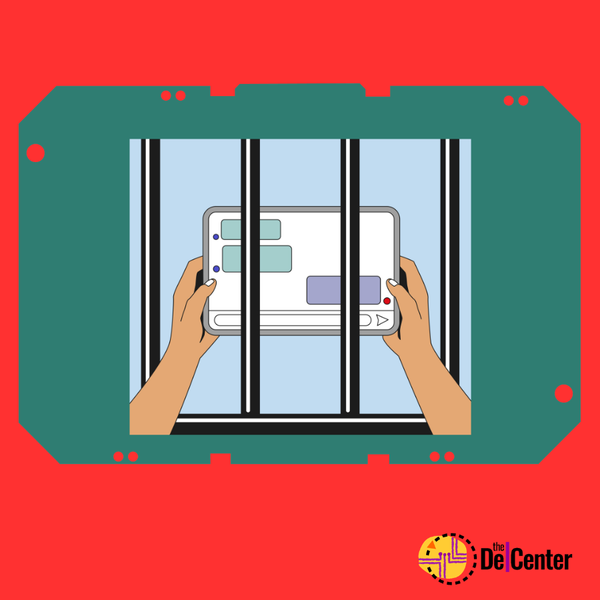
Finally, if you missed it, we rolled our the first in our Spotlight series, an in-depth narrative view from one of our interviewees. This one came from inside a prison in the US.
We encourage you to explore and support the work and voices of our community members. This digest, we're highlighting The Age of Olive Trees by Haia Mohammed, a powerful poetry collection whose proceeds support her and her family in Gaza, and the story of Sheron Edwards, one of our community experts, who is incarcerated in the U.S. Buy, read, share, and show your solidarity.
That's all for now! We hope to see some of you at MozFest. Please reach out if you would like to set up meetings and we look forward to seeing you in person.