Prisons: Where the Future of Surveillance is Tested
With a contraband phone from inside a US prison, one of our experts talks to us about the importance of staying connected. Plus, more interviews and analysis as part of our spotlight series, where we go in-depth.

Don describes his surroundings at a minimum security prison in the Southern United States as Hooverville. He’s referring to the shanty towns and slums that popped up from the east coast to the west of the United States during the Great Depression in the 1930s.
He spoke from the bottom bunk, hidden from view by four sheets that he pulled down like a pillow fort, so as not to be seen. In a large dorm that consists of 50 beds, but only five toilets and sinks, he muses about the past, present, and future. Nearby, the guys sit and play board games at one of the five tables in the common area or watch flat screen TVs that hang on beige walls further dulled by years of smoke. The sound of a running shower comes and goes. The men wear identical green and white striped scrubs.
“They got us all looking like candy canes,” he says. “’Tis the season all year long.”
The reason that Don, who is using a pseudonym for his safety, is an expert in our work at the De|Center, and within the Design from the Margins framework, is because prisons are a microcosm of how authoritarianism functions. This is where Don has learned to read systems and how they proliferate.
To understand carceral technology, it matters to begin in the United States: a country that holds nearly two million people across prisons, jails, immigration detention, youth facilities, and other sites of confinement. America is the most incarcerated country in the world.
The prison system is not separate from the development of surveillance technology; it has helped make those technologies ordinary and is a core reason for its expansion. The history of the “digital prison,”or electronic monitoring, grew through the repurposing of satellites, cell towers, databases, and telecommunications infrastructure into tools of punishment and control.
For Don — a Black man incarcerated in the southern United States, a region shaped in part by slavery, convict-leasing, Jim Crow, prison farms, and ongoing racialized punishment — history is part of the everyday architecture around him.
He has lived inside these systems for more than 25 years, and studied them from the position of someone who could not opt out. He grew up in the South, where like young children across the world, he loved to sing and perform as a way to pass the time. At one point, he pursued music seriously enough to have some success. He is also an author who has tutored, researched, and advocated for massive prison reform. The search for language to describe his lot in life frees him, to an extent, from within the walls that enclose him.
Don was arrested in 1999, when he was 23 years old, on robbery and aggravated assault charges. He was released on bond within a month. His lawyer, he says, warned him that if he were released, he should run because “‘they are out to get you.’”
While he was out on bond, the Police Department, which again we are keeping intentionally vague for Don's anonymity, asked federal agents to arrest him for the same incident under different charges: carjacking with use of a firearm. Don was eventually prosecuted in both federal and state court. He received 20 years in federal prison and another 20 years in state prison, to be served consecutively. That is 40 years total, in both maximum and minimum prisons across the US. The same year that Don was arrested, the median sentence for robbery offenses, including carjacking, was just under six years. So what happened?
For most people in the US, it is common knowledge that a person cannot be charged with the same crime twice, but there is an exception. The dual-sovereignty doctrine holds that state and federal prosecutions are not considered the “same offense” for double-jeopardy purposes when brought by separate sovereigns. In law, this is a jurisdictional rule. In Don’s life, it meant one case could become two sentences for the same crime.
“I did commit the crime, but it didn’t deserve this excessiveness in terms of the sentences,” he says, “I’m a Black man, and at the time I was a young Black man, 23 years old. I committed a crime against a white guy whose father just so happened to be a judge. So you do the math.”
What he later learned, he told us, was that the lead detective in his federal case had been a member of the Ku Klux Klan and had been placed on probation for wearing his Klan robe to work six months before trial. The detail is difficult to move past. It is part of why Don does not experience his sentence as only a sentence, but as a system and structure that multiplies itself around him, like an amoeba.
“I was a product of hate and racism,” he said.
Clarence Okoh, a civil and human rights attorney at Georgetown Law’s Center on Privacy and Technology, situates the surveillance state within what he explains as the “afterlives of chattel slavery,” in an interview for our upcoming report. Okoh outlines that today's carceral technologies do not emerge outside history: they extend a US tradition of producing second-class status, turning human beings into instruments of extraction, and making racialized communities available for dehumanization.
In that sense, risk scores, predictive policing, facial recognition, and other surveillance tools automate punishment and reanimate historical racial violence through the language of data, security, and technological progress.
That is part of what Don has been trying to make legible. The first technology of white supremacy, capitalism, and authoritarianism is a category. A person or community is placed into a category then made into a threat or danger. A punishment is made to seem inevitable and deserved. Then the tools for its expansion arrive with little pushback.

‘They get crazy rich:’ Connection as commodity
Throughout our interviews, different people often came back to the same idea: that in the prison economy, connection is a product. Isolation is enforced, then contact is sold back by the minute. Don explains how official technology is heavily monitored and expensive. When two hours on the phone could cost about $50, calls become unsustainable.
When he was a young man, calls to his girlfriend meant everything. “And so, you know, we're going to spend this money because we’re crazy in love, and now at the same time, they get crazy rich,” he said.
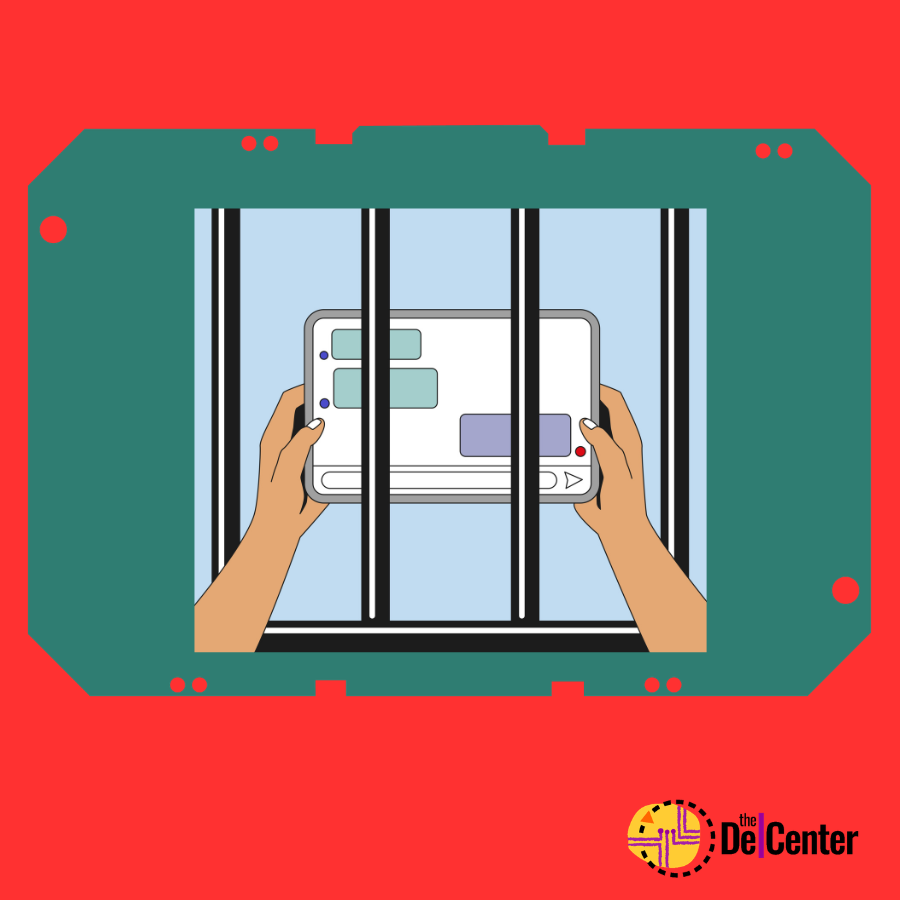
Tablets and Wifi can exist, but often fail.
In state custody, the technology is worse and access is more narrow. The tablets are unreliable. Videos freeze. People have to yell through calls “like down the street in the country,” Don says. If someone wants to stay on longer than 15 or 20 minutes, he says, they can pay for what is called a Gold Pass.
By comparison, he describes the official tablets as “child censored” technology: enough entertainment to pass the time, not enough power to prepare someone for life after prison. There may be music, games, news, and some educational programming, but it is not designed to give people full capacity.
“The technology isn’t helping us to advance,” he says. “It’s only helping us to just do the time by being distracted by something.”
Don’s analysis of technology always returns to money. In prison, costs do not stop with calls. Money sent in is charged. Money spent is charged again. Commissary items are marked up, in some cases by more than 600 percent. Hygiene, food, communication, entertainment, and small comforts all become part of a captive market.
Jasma Credle, an educator and teacher who was formerly incarcerated, describes how basic needs were monetized, rationed, and racialized. At Albion Correctional Facility in New York, she says, white women and Black women could ask for the same item in the package room and receive different answers. Medical needs were treated differently too with the most basic necessities marked up in the commissary. “Once you are considered an inmate, you have no right. You have no voice,” she tells us.
Outside research explains this business model further. The Prison Policy Initiative estimated that people in contact with the criminal legal system and their loved ones pay more than $27.7 billion a year in fines and fees, bail premiums, commissary payments, and telecommunications costs. They also documented the high cost of prison and jail communications and the way phone, video, messaging, commissary, and payment systems can be bundled together. The FCC voted in 2024 to lower prison and jail phone and video rates under the Martha Wright-Reed Act, but enforcement was later delayed and the rules weakened, keeping families exposed to high costs.
“Prison is literally about the money from day one,” says Andre Apparicio, a reentry strategist and the recipient of the community award of the Jamaica branch for the NAACP 2024. He told us about his prior incarceration and described the cost structure from the family side. Calls cost money. The commissary costs money. Stamps cost money.
Prison Policy Initiative found that 74 percent of jails that adopted video visitation also banned in-person visits. They found that Securus, a private company making billions from prisons ,successfully lobbied to require jails to eliminate face-to-face visiting. It meant that families would be forced to do more paid video instead. Recent “Right 2 Hug” lawsuits in Michigan make the same argument against St. Clair and Genesee counties, alleging that jail officials and telecom companies, including Securus and GTL, banned in-person visits and shared revenue from costly phone and video calls. Only after public pressure and lawsuits, Securus said it would remove those provisions.
Authoritarians all over the world use the same tactic.
The playbook is to first block off free and open methods of communication and the internet. Then, offer the public degraded, monitored, and expensive state-sanctioned routes for communication as the only option.
Surveillance technology is tied to payment technology and they all become part of the same ecosystem. Incarcerated people are not only watched, but also charged for basic survival like calling home, eating better food, sending messages, buying hygiene items, accessing media, or maintaining relationships. They become the most extreme example of captive pricing, to say the least, which people would ordinarily associate with high prices at an airport or stadium.

‘You can only say so much:’ Connection as surveillance
Joseph Wilson, who has been incarcerated since 2005, described the arrival of Wi-Fi calling through tablets in New York as a “game changer.” Before that, he had to wait for yard time to call. Now, he told us, he could speak with his daughter before school for the first time.
“My daughter’s nine years old,” Joseph says. “That was huge.”
But still, promise and danger always come as a pair. During our call, the automated recording interrupted with the institutional script:
“This call is subject to recording and monitoring. An incarcerated individual’s use of institutional telephones constitutes consent. And your calls may be provided to law enforcement agencies.”
Consent, in that sentence, means something different than in ordinary life. It is between monitored communication and no communication at all. He also described the dangerous panopticon: “It is an invasion [of privacy and] misused. For instance, there was a young man who was talking to his wife and asked her to bring a [package of] oranges and they said that that meant he was asking for drugs. So like, why couldn't he just ask for oranges?”
Not only is the conversation recorded, but there is an entitlement to interpret meaning as well.
Martin García, our Guardrail Advisor and journalist with The Marshall Project’s News Inside, also describes how prison surveillance extends through calls, tablets, messages, mail, and voice recognition tools. “Any kind of communication… has no expectancy of privacy for an incarcerated individual,” he says. He served 10 years in New York State prisons.
This modern digital incarceration depends on “infrastructural annexation.” It takes systems built for everyday telecommunications — satellites, cell towers, servers, and databases — and turns them into punishment infrastructure.
It is not only the person inside who is watched, but also the fiancee or family member who answers the phone. It’s the child who wants to hear a parent’s voice or the friend who presses “1” because the alternative is silence. Loved ones become data points who are squeezed by costs.
Monitoring inherently shapes relationships. It enters a call before the person on the other end says hello. “You can only say so much,” Don says, “You might want to talk and say something real personal and then go through an introspection phase where you can’t really do it because you know that you’re being monitored by somebody who could just basically use your conversation and what you’re doing just to study you.”
He means the knowledge of being listened to becomes part of the conversation itself. A person begins to rehearse danger before speaking. A loved one does the same. Family members outside the walls are pulled into the system too: their voice, their number, their location, their words, their hesitation.
This surveillance does not only affect emotional privacy. It can affect due process, appeals, defense strategy, and a person’s ability to fight their case. Equal Justice Initiative reported that Securus and Global Tel Link allegedly recorded tens of thousands of confidential attorney-client calls in prisons across at least nine states. They then allowed prosecutors to listen to some of these privileged communications.
When asked how so much information is gathered, Martin came back to one hard-working word: “When you use the word security,” he says, “security gives them a blanket kind of uniform to not be questioned.”

‘Figure out the system, because the system’s trying to figure you out:’ Workarounds in surveilled confinement
Everything is monitored, down to the heart rate. When people need to communicate inside without saying something out loud, they have to get inventive. They use letters called kites, Jasma says. “You didn’t want to say anything out loud because of the fear of microphones, because… [of] the fear of someone listening.”
This chilling effect is brutal for Don, a self-described extrovert. “You got to figure out the system,” he says, “because the system’s trying to figure you out.” Throughout his years on the inside, he has created a network of other incarcerated people and outside contacts that he can activate for his work on prison reform and the falsely incarcerated. He has influenced many lives, partly due to one point of access, which is through contraband.
Contraband phones in particular are the other side of the official story. Correctional systems talk about cell phones almost entirely through security and danger. There are real risks. There are also real punishments for being caught with one. But inside Don’s story, the phone is also a library, a newsroom, a writing desk, a legal research tool, a classroom, and the only channel not fully mediated by the institution itself. “I’ve been locked up 25 years,” he says, “and had I not had access to some of those phones... I would be behind time.”
He means that literally. A phone is closer to the technology people outside use every day and lets him keep a relationship to a society he is expected to reenter after decades inside. He has thus been able to help many to seek justice inside and outside prison. “I’m not saying I’m an animal,” he says, trying to avoid harmful labels. “But it sort of humanizes you. It helps you to acclimatize and get ready for society. Because minus this, you kind of get lost in time.”
This is one of the many reasons why contraband phones are so pervasive in prisons and detentions. They provide a route out of the vast monetization of carceral surveillance. In the US, some of the most important public evidence about prison conditions has come through exactly the kind of forbidden signal that institutions are trying to extinguish. In Alabama, incarcerated organizers and writers involved in The Alabama Solution documented abuses, living conditions, labor exploitation, and state violence through footage filmed on contraband cell phones. The men had spent years documenting prison abuses, bringing lawsuits, and organizing work strikes from their cells. The Marshall Project explains why these phones became an essential tool in their fight with the state because, without them, there would be no way to show how badly conditions had deteriorated.

‘I feel like a lab rat:’ Prisons as testing grounds
The other side of the reality is the testing and experimentation of these tools.
“I feel like a lab rat, in a sense, when I use those tablets, the wall phones, compared to just actually talking to my family, friends, “ Don says. “It’s like they only want to study us just to see, okay, how much punishment can we really inflict on these people and how does this punishment affect them compared to this [other] form of punishment. [...] it’s sort of like data sharing.[…] Sharing information about people. We’re just statistics in order to learn how to improve their systems… They’ll experiment with us using these technologies… and then take them out into society.”
The Electronic Frontier Foundation has documented prison communication companies that build and market voice recognition and surveillance tools around the calls of incarcerated people. The “free” prison tablet model, which has recently been introduced, can expand access to communication and education. Yet, as one of our interviewees points out, it is also creating exploitative pricing, poor service, and new forms of state surveillance.
Jails and prisons have become places where biometric and automated surveillance systems can be built with little consent or oversight in the shadows. The Intercept reported that correctional institutions had built databases containing hundreds of thousands of incarcerated people’s voiceprints, including people held pretrial who had not been convicted.
Voiceprint tracking has shifted from a novel experiment into a standardized, multi-million-dollar pillar of carceral surveillance. Rather than scaling back after an outcry in 2019, prison telecom companies and corrections departments have deeply institutionalized the technology, expanding it from simple voice identification into AI-driven behavioral monitoring and mass legal battles.
The same logic runs through other carceral technologies. In 2022, it was revealed that Verus, an AI call-monitoring system used in prisons and jails, had scanned nearly 300 million minutes of calls, turning everyday conversations with family and loved ones into searchable data. Predictive policing and risk-assessment systems work from a similar premise: that past contact with police, courts, jails, prisons, and parole can be converted into a prediction about future danger.
These are dangerous, pseudo-scientific technologies under the umbrella of predictive policing systems that rely on historical crime data, arrests, victimization patterns, and other criminal-legal records. Together, they become a data environment where people already stripped of privacy are made into raw material for systems that later travel outward into policing, courts, borders, schools, and neighborhoods.
Liam Martin’s history of the “digital prison” shows that digital incarceration was not simply adopted after public debate; it was designed and commercialized in the 1990s by private technologists and entrepreneurs working ahead of formal policy. In 1993, Sandia National Laboratories, a nuclear-weapons research complex in New Mexico, began pushing the “next generation” of electronic monitoring away from landline-based house arrest and toward tracking. In 1994, AT&T filed a patent for a GPS-enabled “locator device” that imagined cellular networks, satellites, and databases as the infrastructure for confinement beyond prison walls. Pro Tech, a small Florida startup, then commercialized that model: its “Satellite Monitoring and Remote Tracking” system, or SMART, was marketed as the “orbiting warden,” and its first major contract with the Florida Department of Corrections gave the company a five-year platform to experiment with the technology.
This is a small glimpse in the history of how incarcerated and criminalized people became both captive users and proof-of-concept for tools that could later be sold as cheaper, more flexible ways to expand punishment without building new prisons.

'They thrive because we are basically livestock:’ The carceral methods do not stay inside
What is tested on incarcerated people does not stay inside. It follows people home through parole, probation, immigration supervision, pretrial release, and reentry. App-based check-ins are sold as alternatives to incarceration but are in fact digital incarceration (or e-carceration) extending incarceration to people’s outside lives. They extend prison logic into homes, workplaces, schools, and neighborhoods as a “virtual prison” that can track location, alcohol levels, or breath. This is done through ankle monitors, GPS tracking, and curfew systems, among others.
Don often describes the system through dehumanization and exploitation. “They thrive because we’re basically livestock,” he says. “As long as they got the livestock inside of the pen... they would continue to prosper. In turn, we continue to decline.”
The carceral system is also a labor-testing ground. Today, incarcerated workers generate billions of dollars in goods and services for private corporations, while often being paid pennies per hour and even the most basic labor protections.
For AI specifically, there are already international examples of incarcerated people doing data-labeling work. In Finland, incarcerated workers have been used to classify data for AI systems, raising questions about whether AI’s need for cheap, repetitive labor will increasingly turn to captive workers.
Don sees the connection between long sentences, bed counts, cheap work, and the businesses built around incarceration. When we asked him about the expansion of migrant detention and whether he saw the same logic moving into that system, he says: “It’s got to be some type of money schema or something behind the whole thing.”
Later, when we described the way prison logic was being used in immigration detention - filling beds, expanding contracts, making people disappear into closed systems - he answered simply: “It’s the same thing. History repeating itself.”
That sentence gets at the full economy. The longer the sentence, the longer the extraction can continue.

‘The unseen hand:’ Transparency in the carceral system to fight authoritarianism
Don is not only a subject of these systems, he is an analyst of them. He understands how bad technology can still matter and that privacy can become a survival practice.
After decades, he says he wishes for more transparency all around. “People in society can become aware of what’s being implemented behind the scenes. The unseen hand, what the unseen hand is doing.”
Secrecy is one of the conditions that lets abuse grow and is why prisons and detention centers belong in any serious conversation about authoritarianism. They show what happens when a state has the power to test and expand controls under security framing. It allows the authority to control movement, speech, information, labor, family contact, and the conditions under which a person may be believed.
Inside the walls, the signal is weak, expensive, monitored, and sometimes illegal.
Still, it moves.
It moves through kites, lawsuits, contraband footage, and the people who refuse to disconnect and allow the institution to be the only narrator.
“As long as you are a community and a body of people working together to combat the machine, you just got to continue to be positive,” Don says. “You can’t let fear bring you down. Fear will divide us.”